Here is a long presentation on Panchayat Planning
Panchayat Planning presentation

Suggestions to India, US, entrepreneurs, and whoever benefits from reading the Blog.
Monday, January 8, 2018

Panchayat Level Planning - Abstract
Collaborative Strategic Planning at Panchayat Level is Essential
to get to a Developed India
Abstract
There is strong optimism that India India
Strategic planning is the key to assuring
citizens that their elected leaders are working on a defined path. This calls
for the development of a series of congruent strategic plans from the national
to state to local level. These plans should dovetail at various levels and
complement one another. Local planning gives ownership of the plan to local
people, takes local inputs, tunes to the environment, allows close monitoring,
responds to feedback, facilitates support, ensures sharing of sacrifices and
results, and leads to success in plan execution. When several thousand
panchayats undertake planning, there is
need for an information technology tool that guides local planners by providing
templates/formats and guidance on how to generate information and data for the
plan. In the next stage, a format processor integrates the information and data
in appropriate ways to create plans for the district, state, and national levels.
For a successful national effort, such a plan development project should be web
based. An initial level format for the plan development tool is described in
this paper.
Monday, January 1, 2018
A Suggestion of a Program to Alleviate Poverty
Here is a document I prepared and sent in March 2014 to a Representative chairing a committee in the US House of Representatives. Of course, there was no response.
Eliminating
Poverty in the US
A
Suggestion[1]
Challenge:
If
a rich nation like the US cannot solve the problem of chronic poverty, no
nation on earth can solve it. Hence, the problem should be addressed here in
the US. The rest of the world may then follow that model to address the poverty
problem in their nations.
While
talking about grand challenges, mission statements, and vision, President
Kennedy is often quoted about the US Moon mission. A similar mission and vision
is required to eliminate poverty in the US. Contrary to the usual practice of
looking at poverty from the point of view of budgets and who pays what, it
should be viewed and addressed from the point of how people invest their time
from childhood through youth and during their professional careers.
Genesis of
Poverty:
Every
human being is endowed with 24 hours a day and they work around 40 hours a work
week. Some have the education, knowledge, skills, abilities, jobs, and
opportunities to earn millions of dollars working for those 40 hours while some
others make nothing during those forty hours. Of course, there is nothing
natural about the forty hour work week. This number is arrived at through
negotiations and discussions over several generations. The nation has
productive jobs with a demand for several billion person hours and people
offering billions of person hours of their knowledge, skills, and abilities. The
total number of hours of work of a particular type is shared by people capable
of doing that work in some proportion with the result that some people actually
work for 40 or more hours while others have work for less than forty hours. Owing
to the nature of the work they perform, some people get very little for their
hours of work. Yet others get no hours of work at all because their type and
quality of contributions do not match the demand or they miss out on
opportunities to get and keep a job. This is the genesis of poverty. No work
leads to no income and ultimately to poverty. This equation is complicated by
the introduction of machines, technology, and global trade into the workforce
as machines also compete with people specifically for jobs requiring low grade
skills and push such people into joblessness and poverty.
Poverty
Alleviation Programs in the Government Budgets:
Governments
try to address the poverty problem by collecting taxes from those earning and
providing grants to the poor. The grant amounts given to the poor people are
barely sufficient to satisfy their hunger while the tax payers feel such
expenditures as a severe burden. First we should ask what moral rights do the
poor have. The House report on War on Poverty (http://budget.house.gov/waronpoverty/) describes a
large number of programs with significant investments. But a reading of the
programs gives the impression that they are band-aids over band-aids without
actually addressing the root cause of the problem.
Sharing
Available Pool of Work:
In
a democracy, national resources are owned by all people and all people have a
responsibility to protect the nation and its resources. Going by this argument,
the nation’s available work hours should be shared by all those seeking the
opportunity to work. If there are more people willing to work than the hours of
work available per person, people may bid to get work for more than their share
of work hours. Winners pay and losers take money to forego their opportunity to
work and earn money.
For
the sake of this quick and simple analysis, let us assume that there is an
average of 36 hours of work available for every person. Hence people who want
to work for 40 hours per week would have to buy 4 hours out of someone else’s
opportunity to work. One who gives up his opportunity to work for 36 hours gets
only 32 hours of work as fulfillment of his opportunity and some cash for the
other 4 hours. Let us assume that we pool such surrendered opportunity hours
and compensated funds obtained in the buy-back process. We will discuss what we
will do with these hours and funds in a latter paragraph.
National Service
Responsibility of People:
It
is also incumbent up on everyone to give a number of their hours to protect,
preserve, and grow a democratic nation. As part of their responsibility, if we
said that people should contribute 4 (out of 40 hour week) to the nation. The
nation may use their time for national jobs. Instead of giving their time to
the nation, some people may opt to buy their time back and work the full 40
hours and earn money. They may pay funds equivalent to the 4 hours of their
time to the nation. This process adds more person hours and funds to the pool.
The Mission of
Eliminating Poverty:
If
we undertake the mission to eliminate poverty in the nation, one major program
is to create productive work. This is really not a government work-at-nothing
program. The pool buys time (person hours) from the unemployed at a certain
hourly rate. In turn, the pool auctions the available hours to the private
sector. By this method, the previously jobless people get paid work that is
productive. With paid jobs, they move out of poverty. If properly priced and managed,
the pool will be self-sufficient.
The
most important point about this idea is not to keep doing this for ever. This
program is not a new form of the current taxpayer funded poverty alleviation
programs. We will explain that feature in the following paragraphs.
Categories of
People:
There
are generally five categories of people who are likely to fall into poverty by
not actively participating in the productive economy.
1.
Children
2.
Unemployed with low grade skills
3.
Old people
4.
Chronically sick and disabled people
5.
Those with attitude problems
The
poverty of children can be addressed by getting them to devote their 40 hours
at school gaining education, knowledge, and employable skills when they grow
up. Such a scheme will eliminate the flow of people into poverty in the future.
The Pool pays for the 40 or so hours given by children so that those financial
resources support the children for food and schooling. In a couple of decades,
the pool of children in poverty should decrease and become infinitesimally
small.
Likewise,
the poverty of unemployed people with low grade skills can be addressed by
getting them to devote some hours to work they can do with their current low
grade skills and some hours to upgrade their skills for better jobs in the near
future. This creates a work force that is reasonably well educated, aptly
skilled, and able and willing to work in the near future. The funding for the
program comes from the Pool. Again, in over a decade, the number of unemployed
should come down to zero thus eliminating the need for the continuation of the
program. By locating the skill enablement centers in low cost areas of the
country, costs as well as distractions can be minimized.
Old
people who have not saved sufficient funds for their old age are the next
category. The pool may pay them to work in jobs that are appropriate for old
people especially in the auxiliary tasks related to educating children and
training the currently unemployable workers.
Chronically
sick and disabled people who have not provided for such circumstances become
the nation’s responsibility. The issues with this group of people should be
addressed by the general budget and by motivating future workers to save for
their old age. This is really a matter of personal budgets, savings, and
insurance to cover risks.
Finally,
there may remain a small group of people that have an attitude problem that may
persist in claiming their rights rather than taking advantage of the
opportunities provided by this or any program. They are a burden and will
become a nuisance if the nation does not persevere in getting them to
rehabilitate. If they are not given an opportunity to become good and
productive citizens, it is the fault of the nation and it has to pay for their
condition. On the other hand, if these people do not take the opportunities
given to them by the nation to gain skills and to work gainfully, it is their
fault and they have no further rights than the charity of the good natured
people.
Program
Duration:
With
the proposed method, the program does not go on forever. The poor are not
supported forever. They are trained and moved into active and productive
workforce. The indolent are given opportunities and failing which they are left
to charities.
By
ensuring that through monitoring the progress of children and youth, their
upward economic mobility is guaranteed. Old people and sick people are also
protected.
The
program scales down as the national average productive work available reaches
the national average worker hours available with due considerations for skill
match.
As
we mentioned earlier, technology and global trade can adversely affect the jobs
of people with various types of stagnant skill sets. By tuning the program,
people’s skills can be constantly monitored and improved and the possibility of
people falling into poverty can be prevented.
Plan Based
Payments:
Just
as businesses are asked to submit a plan when they ask for investment or a
loan, the recipients of funds in this program are asked to develop and submit a
plan of how they expect to get out of poverty. The implementation of the plan
is monitored and reported by the participants, their employer sponsors, and
program managers. The aim of the program
and process is to create confidence in and commitment by the participants to
get out of poverty for good. This planning process should inculcate in people, starting
from their childhood that time is money. One has to invest time in activities
that equip them with skills that get them good jobs and good pay. People have
to prioritize their activities with purpose at every stage of their life.
People have to develop a budget that takes into account what they can earn and
the standard of living they can afford. People well above the poverty line have
a good sense of priorities with respect to their investment of time as they
choose activities. They also pay attention to budget their finances. On the
other hand, the poor need a helping hand in these two aspects.
Conclusion and
Recommendation:
It
is time for the US to set up a national program to eliminate poverty in the
foreseeable future. Congress is requested to consider the suggestion made here
and launch a program in place of the hundreds of disconnected programs in the
current budgets.
Saturday, December 30, 2017
Modeling Immigration
Modeling Immigration Similar to Thermal Systems Models
By Som Karamchetty
Modeling Concept:
Immigration is usually discussed and
described as the number of people moving to a country. But, immigration is much
more than people moving. People bring or take with them a number of attributes.
They carry wealth, education, knowledge and skill capabilities, innovative
abilities, behaviors, and so on. Therefore, it is important to consider them in
a mathematical model.
In engineering, thermal systems are
modeled in terms of mass and energy balance. Mass transfer is accounted for in
mass balance or the law of conservation of mass. Energy transfer is accounted
for in energy balance or the First Law of Thermodynamics. It may further be
noted that energy comes in many forms and various forms of energy are
considered as applicable to a situation.
In the case of immigration, we may account
for people in a balance similar to mass balance. Wealth transfer may be
considered in a manner similar to energy balance. Like energy, wealth also
comes in many forms as explained in the formulation of the model in the
following sections.
In thermodynamic systems, when energy
transfer takes place from one form to another, the conversion may not take
place at one hundred percent efficiency. This is explained in terms of the
Second Law of Thermodynamics. In the case of wealth transfer from one form to
another, certain conditions may prevent the one hundred percent conversion.
Here is a suggested model of immigration patterned
after the systems modeling approach normally used in thermal systems modeling. As
in the case of the thermal systems models, we use a modeling approach that uses
a system and surroundings.
Immigration Model:
Following the thermal systems analogy, we take
a country as the System and the rest of the world as Surroundings with
immigrants and emigrants as shown in Figure 1.

Figure 1: System and Surroundings
- with People Balance
First, we apply a relationship similar to the law of conservation of mass or the mass balance. It is also called the mass flow equation in thermodynamic (or fluid flow) systems. In case of immigration, let us take into account the number of people in a country before and after a certain number of people enter as immigrants and another group of people leave as emigrants during a certain period.
Suppose a country A has Nci number of
citizens. Now, if n1, number
of people immigrate from the rest of the world to country A, and if n2,
number of people emigrate from the country A to the rest of the world, country
A will have Ncf number of citizens and residents, the following
equation applies.
Nci
+ n1 - n2 = Ncf (1)
Where,
Nci is the Number of Citizens
or people in the country initially,
n1 is the number of immigrants
that entered the country,
n2 is the number emigrants that
left the country, and
Ncf is the number of citizens
or people in the country finally.
Suppose that the net wealth of each citizen
(or resident) of country A is hi and the people immigrating (entering a
country) have a net individual wealth of h1 and the people emigrating (leaving
the country) A have a net individual wealth of h2, then the net wealth of each
citizen of the country A changes to hf and the following equation applies to
the wealth of the country.
Nci * hi + n1 * h1 - n2 * h2
= Ncf * hf (2)
This equation
is similar to the Energy Equation or the Law of Conservation of Energy or the
First Law of Thermodynamics.
Country A may receive a certain amount of
wealth from another country in the world or give some wealth away to other
countries in the world without any people carrying that wealth.
Suppose the country A receives an amount
of wealth Win from the rest of the world,
and gives away an amount of wealth, equal to Wout, to the rest of the world,
then the following equation applies. This is shown in Figure 2.
Nci * hi + n1 * h1 - n2 * h2
+ Win – Wout = Ncf * hf (3)
Equation (3) has units of wealth,
dollars.

Figure 2: Wealth Balance with Immigration and Emigration
When people move across countries’ borders,
they bring with them their capabilities like education, innovative capability,
and so on. These capabilities are similar to chemical energy, catalytic
capability, and so on in a material. In order to take these capabilities into
consideration, we can apply various enhancements to this basic equation (3)
showing wealth balance.
Suppose the country A has an average
individual education level ei and the arriving immigrants
have an average education level of e1 and the emigrants have an
average education level of e2, then the average education
level of country A changes to ef and the following equation
applies.
Nci
* ei + n1 * e1 - n2 *
e2 = Ncf
* ef (4)
Equation (4) has units of
education.
After immigrants arrive in the country A
and a certain time lapses, they will use their educational qualifications to
create wealth. It will be somewhat like a chemical reaction occurring and
generating thermal or other energy. In that sense, education level will be like
chemical energy in a material. Using such an analogy, we can use the wealth equivalent
for education and write Equation 5, below.
Nci * hei + n1 * he1 - n2 * he2
= Ncf *
hef
(5)
By combining the Equations 3 and 5, we get
the combined wealth and education balance shown in Equation 6.
Nci * hi + Nci * hei + n1 * h1 + n1 * he1 – n2 * h2
– n2 * he2 + Win – Wout =
Ncf *
hf + Ncf * hef
(6)
By
substituting the following relationships,
he1 = K * e1
he2= K * e2
hei = K * ei
hef = K * ef
, using k as a
constant to convert the average education level to average wealth equivalent,
into Equation (6), we get
Nci
*
hi + Nci * K * ei + n1 * h1 +
n1 *
K * e1 – n2
*
h2 – n2 * K
* e2 + Win – Wout
= Ncf * hf
+ Ncf * K * ef (7)
Some immigrants bring their capability to
invent and innovate whether or not they possess wealth and education with them.
Over time, their ability to innovate creates wealth. Let us say, I is the
average innovative ability of a person. Innovative ability is similar to
catalysts. (Catalysts may not possess energy but can help release thermal
energy from other materials.) But, in a country where there is wealth (to
finance enterprises), educated people to create and manufacture products,
innovators can convert their ability to innovate into wealth over time. Now, we
can add this ability to innovate and rewrite the equation 7 as follows.
Ii is the innovative ability of
existing citizens in the country A, I1 is the innovative ability of
the immigrants, I2 is the innovative ability of emigrants, and If is the innovative ability of
the final citizens of country A.
We use hIi as the wealth equivalent of innovative ability of initial citizens, hI1 as the wealth equivalent
of innovative ability of immigrating people, hI2 as the wealth equivalent of innovative ability of
emigrating people, and hIf is the wealth equivalent of
innovative ability of final citizens. We get
Nci
*
hi + Nci * K * ei + Nci * hIi
+ n1 *
h1 + n1 * K * e1 + n1 * hI1 - n2
*
h2 – n2 * K * e2 - n2 * hI2 +
Win – Wout = Ncf
* hf
+ Ncf * K * ef + Ncf * hIf (8)
If q is a
constant that denotes conversion of the ability to innovate in to wealth, we
get
hI1 = q * I1
hI2 = q * I2
hIi = q * Ii
hIf = q * If , and
substituting these equivalents into Equation 8, we get
Nci
*
hi + Nci * K * ei + Nci * q * Ii
+ n1 *
h1 + n1 * K * e1 + n1 * q * I1 - n2
*
h2 – n2 * K * e2 - n2 * q * I2 +
Win – Wout
= Ncf
* hf
+ Ncf * K * ef + Ncf * q * If (9)
It may be noted that in the above equations, the average values for
wealth of people, the education level, and the innovative ability are used. In
order to get finer details, we can define the average values for each of these
values for smaller segments and sum them up. Such modeling will follow the
models used in multi-component, multiple types of energy systems in thermal
modeling of chemical systems.
Conclusion:
These simple equations allow us to
calculate and quantify the merits and demerits of certain types of immigration
to the wealth of a country. Such modeling and simulations would help countries
as they develop immigration policies.
If immigrants bring education level and/or
wealth, and/or innovative ability greater than the average
existing education level and/or wealth, and/or innovative ability in the
country the country’s wealth increases over time.
On the other hand, if immigrants bring
education level and/or wealth, and/or innovative ability less than the average
existing education level and/or wealth, and/or innovative ability in the
country the country’s wealth decreases over time.
More detailed analysis may show the
linkage between the types of education and skills an immigrant brings to a
country and helps in innovation using locally available resources.
Adult immigrants that come with good
education and skills gained in a low cost country would actually save
educational costs as opposed to child immigrants as children normally do not
have educational qualifications, or wealth, or innovative and catalytic
abilities. However, children will contribute to future wealth as citizens and
are likely to have little effect on the culture of the country A.
Immigrants also consume products and
services and thus create jobs and economic activity. It will be interesting to
explore the effect of immigrants via the market on the creation of wealth in a
country.
Immigrants’ behavioral characteristics
would also have a strong effect on the wealth of a country; it can be captured
in the equations.
The equations actually formulate simple
relationships but by looking at them in this way, one can be inspired to
develop the relationships and assist the decision makers.
For example, such a model would provide an
answer to a question, such as, ‘is it better to give money to a country rather
than allowing its poor citizens and illiterate people to immigrate’ from the
perspective of country A.
Tailpiece:
Since I talked about the Thermodynamic
system model in the analogy, one might be justified to ask if the Second Law of
Thermodynamics can also be applied. The answer is a resounding ‘Yes.’ If a
person with high educational and/or innovative ability is not allowed to excel,
(by giving such a person a menial job as opposed to a deserving position), the
inherent capability is not utilized by the country A.
Tuesday, December 26, 2017
Virtual Experiment Farms
Virtual Experiment Farms
I hope that this SP Jain School’s effort gives impetus to such broad initiatives into business ventures. With the emerging Augmented Reality and Virtual Reality Technologies, and Virtual Experiment Farms, engineers will be fully conversant with a variety of technology systems and components. I posted my concept of Virtual Experiment Farms on Facebook.
Here is the SP Jain School news.
SP Jain School of Global Management rolls out virtual labs in emerging technologies
By Brinda Dasgupta, ET Bureau|
Dec 12, 2017, 01.39 AM IST
[…]
In our college days, we used to conduct scores of experiments on engines. But, we gained little knowledge about the basics, design, manufacture, and maintenance of engines. This practice is repeated by several other labs (e.g. hydraulic machines, strength of materials, and so on). With over two thousand engineering colleges in India, the same process is still repeated.
In practice, when one goes to the major manufacturers, one will find that the engines are in test cells and the experiments are conducted from outside the cells via computer and communication equipment. The knowledge and skill required is in setting the experiments, which the Indian engineering colleges do not teach at all. Students are not even allowed to play with old machines by disassembling and assembling them.
I believed that a handful of experiments with remote machines equipped with cameras to view them and Internet connection to remotely operate them and test data taken by students from their own locations would help. In order for students to gain deep knowledge of machines, there should be old machines available for them to play with. Students should be given training in how to build test setups.
With a handful of Virtual Experiment Farms with a number of machines equipped for remote testing, thousands of colleges can be served. By operating the system on a 24X7X365, overseas colleges can also be served. It will be cheap to provide experimental work for engineering students in India and globally. Country’s resources and students’ time can be dedicated to gaining hands on experience by playing with a few representative machines, components, and materials.
3. In
2005, I sent a letter to a Professor friend suggesting the concept called,
Virtual Experiment Farms. (I am posting it here after removing his name and
address as I do not have his permission to use his name here. In my original
letter, I use a company name, which I changed to ABC in this note.)
Dear Professor …:
It
was a pleasure meeting you again at the Pan-IIT Conference in Washington, D. C.
during 20-22 May 2005. First let me congratulate you on your attaining a high
position of stature and responsibility. I know you will do a great job in that
position.
Having gained
experience in higher education and high technology in India at Kharagpur,
Australia and now in the US for the last 26 years, I have been contemplating
several concepts that can revolutionize higher education in India. I would like
to take the opportunity of your chairmanship of this great committee to suggest
some of the concepts for your review in due course. For now, however, permit me
to submit a simple idea that can have far-reaching positive benefits. I suggest
a concept called virtual experiment farms.
Capsule Description:
The
concept concerns experimental facilities for students of engineering colleges
in India. A number of experiments are set up in one location, with students
from a number of colleges conducting experiments on those machines remotely via
the Internet. For example, a number of engines can be set up in a farm with
instrumentation and Internet connections. A number of video cameras show
different views of the engines. Students from a large number of engineering
colleges can run experiments on these machines by scheduling time on the
machines. There are a number of advantages in this arrangement.
Affordability:
The greatest advantage is that each college does not need to buy, set up, and
maintain expensive laboratories. Experiments can be standardized.
Technology and Logistics: Students get to run experiments remotely, a trend that is both
advanced and modern. For example, U S and European automobile companies conduct
their experiments in test cells with engines instrumented and operated remotely
from outside the test cells. Experimenters are not exposed to the harmful
emissions from the engines. Experimenters’ safety is enhanced by keeping the
machines inside test cells. Students will be right at home with the skills and
experience they gain with this set up. They get results into their computers
and can analyze them readily and rapidly. For example, NASA conducts tests on
satellites remotely via networks; they gained considerable experience in remote
testing or experimenting. The technology is very simple. Conventional machines
or systems are instrumented and connected to the Internet. Local operators
maintain the systems and keep them operational. Students at remote sites
conduct experiments and get results via the Internet.
Utilization:
Students of various colleges in the Indian university system can conduct tests
by scheduling their time on the machines. The machines can run at a high load
factor thus reducing unit costs for each participating university or college.
Supplementation for Hands-on Experience: Will the students lose hands on experience? Each college may buy
used-systems (machines or engines) and allow students to disassemble and
assemble those systems to gain valuable hands-on experience. Personally, my
students and I gained considerable experience by rebuilding old engines and
inventing new thermal cycles at Kharagpur. Both in Australia and the U S, I
realized that people learned a lot about their automobiles and other machinery
by working on those machines. Student experiments by themselves do not give
insights into machines; they provide lessons in system behavior and
characteristics. Students gain creative design and fabrication experience by
playing with machines, which can be done on a large variety of used machines.
Extensibility:
The virtual experimental farms are extensible to electrical machines, hydraulic
machines, structural testing, aeronautics, naval systems, and so on.
The Big Leap:
The advantages can be extended internationally. If some Indian universities
take the lead and offer the services of its facilities nationally, thousands of
Indian engineering colleges can use a few virtual experiment farms. That leads
to enormous cost savings and standardization in experiments. Since the Internet
is global, such services can be offered to other countries also. U S and Europe
are lamenting on the fact that their universities are cutting down on experimentation
as costs are escalating. Well, with Internet and virtual experiment farms, they
can conduct as many experiments as they wish. By locating the facilities in
India, the costs can be affordable. That is another form of outsourcing revenue
for India. By offering such services to African, Asian, and South American
nations, India will be assisting the development of their professional
engineering manpower. That is enormous prestige for the nation!
Technical Feasibility: Can it be done? Yes! In 2003, I visited the ASME and RD&D
Exposition in Washington, D.C., USA. One exhibit attracted me the most. [ABC]
company's Technology Exploration Products. I discussed their products at length
with their President, Mr. [ABC].They make and sell a number of experimental set
ups. They have wind tunnels, electric motor test beds, and engine test beds.
(Please note that I am neither their agent nor do I represent them. Neither do
I endorse their products nor do I recommend them.) One can test an engine and
get the readings on a laptop computer connected to the system. A particular
system costs $15.8K plus $5K for data acquisition module and a laptop computer.
They have cheaper as well as more expensive versions of the engine test
modules. The additional development needed is to write software to make the
testing compatible with the Internet. Of course, Indians have proven to be
great at such software development. The system is technically feasible,
economically viable, and can be demonstrated in a very short time. As I
mentioned in a previous paragraph, NASA has conducted highly sophisticated
remote experiments on satellite systems for a long time. It is possible that
Indian experimental equipment manufacturers will gain the technology and build
these systems for a variety of technologies.
What is the market? With thousands of engineering colleges in India, one can sell the
services and maintain a high load factor on the machines or test
sets. Since the Indian technical education market is mostly government
owned or controlled, with some newer private colleges affiliated to
universities, the governments are the market. Their objective is to increase
student throughput, maintain quality, and reduce costs. That is a very ready
and favorable market for virtual experiment farms.
Financing: I
believe that the governments and universities should finance an initial (or
pilot) capability. Thereafter, the universities can prescribe standards and
allow private enterprises to build, and operate the facilities. In such an
arrangement, the investors can cater to the Indian needs and concurrently sell
their services in the overseas markets. They can operate 24x7x365. Indian
enterprises have already built an excellent record in the off-shore outsourcing
area in back office operations. They can move to the forefront in testing.
Outsourcing of Testing: As Indian engineers, professionals, and managers gain experience
in the experimentation area, overseas manufacturers are likely to offshore
their product and system testing operations to India as a cost-containment
measure. The virtual experiment farms will be in India (conducting tests on new
engines, machines, and systems), while the manufacturers and developers in
Europe and the U S get results via the Internet. This will be another feather
in the Indian off-shoring cap!
Commercial Potential: There was a news item, which stated that John Deere & Co is
setting up an outsourcing and R&D center in Pune. According to the report,
the company will employ 500 people to provide information technology and
engineering testing services for Deere & Company's global operations.
(Source: http://www.siliconindia.com/shownewsdata.asp?newsno=26740&newscat=Technology) This industrial example is a case of an experiment farm in India
with both Indian testers and overseas testers performing experiments to test
system performance.
The Next Steps: The first step consists in selecting a pilot project with one set
of experiments and building a system and a farm. That can be followed with
identification of a number of high value opportunities and extending the
facilities.
I appreciate your time in reviewing this
suggestion. I will be very pleased to discuss the concept further and help you
in any way I can if you decide to champion this concept. I can be reached at
the phone or email address given above.
With best regards,
Sincerely,
[Signed]

4. A few years ago, Mr. Ashok Syal, an experienced
entrepreneur & friend, and I decided to pursue this concept with the chairman of the
company [ABC] I mentioned in my above letter. We met at Mr. Syal’s office in Virginia, USA, and
discussed over a luncheon meeting. By that time, [ABC] has systems that can do
experiments over the Internet. He was offering the Experiment facilities over
the Internet to US colleges at $250 an hour. Ashok offered that he can bring investors and a
large market if [ABC] agrees to set the ‘Farms’ up in India. [ABC] mentioned to
me that he would like to protect his technology and did not wish to collaborate
with us.
5. I sent the concept to several other friends in high
positions in India. Professor Prem Vrat, former Director of IIT, Roorkee, and
Pro-Chancellor of North Capital University (formerly ITM University) in Delhi, and a friend, sent me (a few years ago)
a news item that showed that his university and IIT, Delhi have a virtual
experiment arrangement for the students of his university.

6. I found that IIT, Delhi has a link to the Virtual lab http://iitd.vlab.co.in/. While it is a good
idea for IIT to develop such a facility and technology, it can be a great national
and global business if Virtual Experimental Farms are set up by private
industry as suggested by me over a decade ago.
Monday, December 25, 2017
Solar Coolhouse Concept
Solar Cool Houses in the Desert
{A patent spec prepared and then postponed for the time being.}
Abstract
Solar Cool-houses are like traditional
greenhouses but a significant difference is that they create a cool environment
for plants to thrive in an otherwise harsh (hot and dry) environment. They will have
transparent roofs covered with transparent solar photo voltaic (PV) panels and hot water
heaters. During the day under the sun, the transparent PV panels produce
electric power which can be used to generate chilled water or cool air to keep
the greenhouse environment cool. Locally available non-potable water or sea
water is heated in the water heaters and through desalination process, convert
it to water suitable for plants.
As global population increases, there is a
greater demand for food, water, and energy. Solar photovoltaic (PV) systems are
increasingly used as energy generators. But, such systems occupy large tracts
of land competing for land, which is needed to grow more food. Solar cool houses
can be built on the vast tracts of currently waste lands that are desert like,
fallow, and barren. Thus, such lands in the harsh, hot, and dry desert-like
environments can be converted into flourishing crop lands.
By a proper selection of materials for the
solar cells for the PV panels, the wavelengths of light in solar spectrum that
are utilized for photosynthesis are passed through to the plants in the
cool-house. Thus, one hundred per cent of the energy in the solar radiation
incident on the roof is absorbed by the PV panels, the plants, and the water in
the hot water heaters.
Any excess or deficit of electric energy
generation in a solar cool house complex is exchanged with the electric power
grid. Deserts and arid lands usually have very inferior soils. In such
locations and situations, hydroponics, and pisciculture can thrive in the cool houses.
BACKGROUND
Field
of the Invention:
This
invention relates to solar coolhouses to create a suitable environment to grow
plants in an otherwise harsh hot and dry desert-like environment while
generating electric power with transparent solar photovoltaic (PV) panels on
top of the coolhouse roofs.
The
present invention describes a coolhouse that has transparent solar PV panels
fixed to a structure with a transparent roof to create an environment suitable
to grow plants in the coolhouse. Solar radiation of certain wavelengths is
essential for photosynthesis, a biochemical process through which plants take
advantage of sunlight and generate life sustaining vegetable foods. But the
severity of the solar radiation in a desert is highly detrimental to vegetation.
Another aspect of the present invention is directed towards using a part of the
energy from the solar spectrum to generate electricity through transparent photo
voltaic (PV) panels on the roofs, using another part of the solar radiation to
heat sea water for desalination, and allowing the rest of the solar radiation
spectrum to be used by plants for photosynthesis. This effect is accomplished
by properly shielding the crops from the full impact of direct solar radiation
and by distributing the solar radiation by suitably building coolhouses to allow
plants to thrive. The electric energy generated by the transparent photovoltaic
panels is used to generate clean water needed by the plants from sea water or
hard water by desalination and to run the air conditioning equipment to create
a thriving environment in the coolhouse and any excess or deficit of electric
energy generation is exchanged with the electric power grid.
Deserts
and arid lands usually have very inferior soils. In such locations and
situations, it is proposed to use the coolhouses for hydroponics, and
Pisciculture.
Description
of the Related Art:
As
global population increases, humans depend on every acre of land and every
gallon of fresh water to raise food needed by the billions of people in the
world. Life sustaining food results from agriculture, which critically depends
on land, fresh water, energy, solar radiation, and proper environment.
As
they run out of fertile farm lands, nations have been trying to cultivate new
lands that are dry, arid, fallow, and desert like harsh environments. Constant
efforts are being made to bring new sources of water including desalination of
seawater and reuse of dirty and hard water. New and affordable sources of
energy, where available, are being applied to improve agriculture. Technology
and designs to augment solar radiation in extremely cold as well as hot and dry
climates are being applied in concert with other methods to improve agriculture
and gain better yields.
In
cold climates, greenhouses are built to augment the local environment to extend
the periods when vegetables and fruits can be grown. Greenhouses are also known
as glasshouses, hothouses, or coldframes. These structures are covered with a
transparent layer made of plastic film, rigid plastic, or glass. The cover
permits natural light to enter to allow plant growth but prevents cold air to
enter or warm inside air to exit. The inside temperature is maintained by
heating with an external source as needed. Although most of these efforts are
expensive in terms of initial costs, cultivation of proper vegetables, fruits,
flowers, and other crops results in attractive economic returns.
Desert farming generally relies on irrigation with the Imperial Valley
in California is a good example of successful desert farming. One
problem associated with raising traditional plants in a desert is depletion of
the ground water.
Drip irrigation is one way to reduce the overall water demand especially in
desert areas.
The geography of Israel is not naturally conducive to
agriculture as more than half of the land area is a desert, the climate is
harsh, and the country lacks water resources. With hot daytimes and cold night
times, hothouse technology is used to grow vegetables in that country.
SolarSpring
developed clean-energy water systems in remote areas by using solar
photovoltaic systems to desalinate and treat seawater and non-potable water. Solar
thermal energy is used to heat and evaporate seawater or dirty water and the
water vapor is subsequently cooled to produce clean water by a process called,
solar humidification-dehumidification (HDH) process. The energy required for pumping
the water is powered by solar photovoltaic panels. The creation of fresh water
by the desalination of water using the waste heat from Concentrating Solar
Power (CSP) plants—a welcome bonus in arid regions.
In the interior areas of continents, other water sources, such as, groundwater
with mineral contaminants (e.g. Arsenic), degraded wells, and streams with
mineral contamination, are available but cannot be used directly for
agriculture. Zonnewater BV developed an
optimized solar thermal distillation system. It is intended to produce premium
drinking water as well as water for agricultural applications from different
available sources in tropical and sub-tropical locations.
A pilot plant
built by the Sahara Forest Project (SFP) produced 75 kilograms of vegetables
per square meter in three crops annually, comparable to commercial farms in
Europe, while consuming only sunlight and seawater. SFP designed a special
greenhouse in Qatar. At one end of the greenhouse, salt water is trickled over
a grid-like curtain so that the prevailing wind blows the resulting cool, moist
air over the plants inside. This cooling effect allowed the facility to grow
three crops per year, even in the scorching summer. At the other end of the
greenhouse is a network of pipes with cold seawater running through them. Some
of the moisture in the air condenses on the pipes and is collected, providing a
source of fresh water.
While
traditional methods of agriculture use vast quantities of water, and fertile
soil, hydroponics utilizes several times lower quantities of water and uses no
soil at all. Plants are grown in inert medium or in water itself. Of course, in
either case, liquid nutrients are added to water.
Pisciculture
improves on hydroponics as it allows both fish and crops to grow together. The
plants thrive by using the rejects from fish as supplementary nutrients and the
fish use parts of the plant as food. Pisciculture also uses less water than
traditional agriculture.
With issues of
climate change and greenhouse gases putting pressure on fossil fuel-based
thermal plants, solar photovoltaic energy generation is gaining favor. But,
this trend would take away vast areas of land from agriculture when the PV
plants are situated on ground. There is a hope that there is potential for
growing plants for food and
other uses in the shaded areas under the solar mirrors. It is also possible to
use desalination of sea water to water the plants. But without full enclosures,
hot winds and fierce sand storms will still cause problems for plant
cultivation in the deserts.
Every year, each
square kilometre of desert receives solar energy equivalent to 1.5 million
barrels of oil. Multiplying by the area of deserts worldwide, this is several
hundred times as much energy as the world uses in a year. Hence, there is a
constant effort to utilize solar energy fully and benefit from it.
Figure
1 shows the solar radiation spectrum. Solar radiation spans wavelengths from
250 nanometers to 2,500 nanometers covering the Ultra Violet (UV), Visible, and
Infra-Red (IR) regions. Plants use only some of the light in the 400–700 nm range. Hence, 47% of
the incident solar radiation comprises non-bioavailable photons, which is not useful for photosynthesis of the
plants but is converted to heat under normal circumstances.
Of
the global radiation reaching Earth’s surface as shown in Figure 1, on average,
45% of the incoming solar radiation falls within the range of 389 to 710 nm.
This is the range utilized via photosynthesis by plants. This range is often
defined as photosynthetically active radiation, PAR, and is often denoted by
the range between 400 to 700 nm as shown in Figure 2. It may further be noted
that of the 100% total energy received by the leaf, only 5% is converted into
carbohydrates and later for biomass production. The amount of energy lost by
nonabsorbed wavelengths is thus 60%; this energy is reflected by the plants
into the surrounding atmosphere.
Figure 2 also shows the response of various types of
chlorophyll in plants to light. This examination of the characteristics of
plants reveals that plants use sunlight within the visible range and even
within this range, there is a certain capacity that plants can use and the rest
of the light incident upon them is dissipated as heat. Plants differ in the
types of chlorophyll they use in using sunlight, a fact worth noting in the selection
and design of agricultural or crop systems.
When we examine the solar to electric energy
conversion mechanisms, it is known that when light is incident on a material,
it is partially reflected, absorbed, and transmitted. Only that portion, which
is absorbed, is converted to electricity in the photovoltaic panels. These
fractions depend on the materials. There is constant research and development
to discover and formulate new materials with high absorption values. These
absorption values are typically dependent on the wavelength of the light
impressed upon them. Thus, it is possible to select combinations of electronic
materials that absorb solar radiation at wide wavelengths but allow light of
certain selected wavelength range to pass through for other potential uses.
Figure 3 shows the
spectral response of a selected set of popular materials used for solar cells.
Gallium Arsenide (GaAs), Cadmium Telluride (CdTe), amorphous Silicon (a-Si), crystalline Silicon
(c-Si), and Copper Indium Selenide (CIS) are some of the materials used in
solar panels and it may be noted that each material absorbs light (photons)
within certain specific wavelengths of the radiation and converts it into
electrical energy. The rest of the radiation is passed through the solar panel
in transparent materials. With most materials currently in use, the amount of
energy absorbed for conversion to electricity is only a small fraction of the
incoming radiation. With solar panels operating with efficiencies in the range
from 6% to 18%, it means that a large fraction of incident photonic radiation
is available past the solar panels. For example, (CIGS) cells on glass give
efficiency between 18.1% and 14%, and
flexible CIGS cells on polymer and metal foils give 16% efficiency, solar cells
with non-vacuum low cost CIGS process give 6.7% efficiency, CdTe cells on glass
give 15.4% efficiency, and flexible CdTe cells on polymer give 12.4%
efficiency. In almost all these cases of solar panels, a high proportion of the
incident radiation is available for other uses.
Indium tin oxide (ITO) can be used in nanotechnology to provide a path to
a new generation of solar cells. Solar cells made with these devices have the
potential to provide low-cost, ultra-lightweight, and flexible cells with a
wide range of applications. Because of the nanoscale dimensions of the
nanorods, quantum-size effects influence their optical properties. By tailoring
the size of the rods, they can be made to absorb light within a specific narrow
band of colors. By stacking several cells with different sized rods, a broad
range of wavelengths across the solar spectrum can be collected and converted
to energy. Moreover, the nanoscale volume of the rods leads to a significant
reduction in the amount of semiconductor material needed compared to a conventional
cell. Thus, ITO solar cells can generate electricity and also allow light at
frequencies useful for photosynthesis by plants.
Thin
film photovoltaic cells are made by depositing one or more thin layers of
photovoltaic material on a substrate and they offer lower production costs and
acceptable efficiency values. The sub-groups of thin film photovoltaic cell
include amorphous Silicon (a-Si), Cadmium Telluride (Cd-Te) and Copper Indium
Gallium Selenide (CIS or CIGS).
Polymer
solar cell (PSC) produces energy by absorbing infrared light and is not
visible. The cells are thus nearly 70 percent transparent to the human eye.
Made of photoactive plastic, the cells have been seen as highly viable
solutions for building integrated solar installations. They are fabricated in
long sheets suitable for building materials. Such Building Integrated
PhotoVoltaics (BIPV) will suit special applications in greenhouses.
By
taking conventional opaque PV materials and either making them so thin they are
translucent or “segmenting” them, “see-through” solar cells could be made with
some tradeoff between transparency and efficiency. Such a tradeoff is not
entirely negative if the transmitted energy in the light is used by the plants
and the hot water heaters. From Figure 4, we can see that transparent solar
cells fulfill these requirements admirably. These cells utilize the UV and
near-infrared (NIR) light to generate electric energy and pass the visible
light through.
MIT
researchers are making transparent solar cells (Figure 4) that could turn
everyday products such as windows and electronic devices into power
generators—without altering how they look or function today. These solar cells
absorb only infrared and ultraviolet light. Visible light passes through the
cells unimpeded. Using simple room-temperature methods, the researchers have
deposited coatings of their solar cells on various materials. They estimate
that using coated windows in a skyscraper could provide more than a quarter of
the building’s energy needs without changing its look.
Michael Grätzel produced the most
efficient Perovskite solar cells, which convert 15 percent of the energy in
sunlight into electricity. It is expected that future cells made with this type
of materials could result in efficiencies as high as 20 to 25 percent.
Perovskite solar cells can be made by spreading the pigment on a sheet of glass
or metal foil, along with a few other layers of material that facilitate the
movement of electrons through the cell. With such photovoltaic materials it is
possible to paint or spray solar cells on transparent roofs. Transparent
PV panels are available commercially as fabric and a commercial sample is shown
in Figure 5. It is also possible to stack up such fabric based solar cells over
water heaters made with the transparent fabrics.
The performance of
PV cells improves when they are cooled. Hence, by locating a hot water heater
below the transparent solar PV panels, we accomplish three things: 1) the
performance of the PV panels is improved; 2) the intensity of harmful solar
radiation reaching the plants is reduced; and 3) the heat recovered by the
water is usefully utilized in the desalination process.
The integral
passive solar water heaters (IPSWH) are typically rectangular plastic bags
holding water for heating. These
were popularly called "solar pillows" A similar model, with a simple
tray instead of bags, has also been used. The point is to minimize the thermal
energy reaching the plants in the desert environment and where possible to
utilize the collected thermal energy.
It
is known from the above description that 1) solar photovoltaic systems are not
100% efficient; 2) they do not use the solar radiation present in the entire
spectrum of sunlight; and 3) plants do not use all the sunlight they receive. Hence
technologists look for ways to develop systems that take advantage of the
mutual inefficiencies and indifference of system components to parts of the
light spectrum.
Bhatt
(US Patent 5,101,593) described a Portable greenhouse working on solar system.
He disclosed a closed chamber with windows that permit the entry of light into
a major part of the chamber where plant growth will occur while restricting
light to a minor portion thereof where germination of seeds occurs. Racks for
stacked growing trays are provided; preferably the upper part of the chamber is
used for germination. The greenhouse further includes apparatus for
accumulating solar energy in the form of electrical energy so as to drive
irrigation pumps and fans and also in the form of thermal energy to assist in
maintaining desired temperatures in the chamber.
Hajj
airport terminal uses for its roof a Birdair
provided translucent membrane material to shield the interior from the high
temperatures in the desert. That material keeps 70% of the light from entering
the interior.
SUMMARY
One
object of the invention is to develop an enclosure to allow only a controlled
portion of sunlight to impinge on the plants inside the said enclosure by
providing a transparent roof covered by successive layers of transparent solar
photovoltaic panels and transparent solar hot water heaters to produce fresh
water from sea water by desalination, which fresh water is used to feed the
plants raised in the said enclosure, and to create controlled temperature and
humidity conditions suitable to raise vegetation by supplying cooled air
produced by an air conditioning or chiller system powered by using the
electricity generated by the above mentioned solar panels and augmented by grid
power.
BRIEF
DESCRIPTION OF THE DRAWINGS
Figure
1 shows the solar radiation spectrum
Figure
2 shows the rate of photosynthesis and the amounts of sunlight in the various
wavelengths that are absorbed by the chlorophyll in plants.
Figure
3 shows Spectral Response of solar
cells.
Figure
4 shows Spectral response of
conventional and transparent PV cells
Figure
5 shows a sample of a commercial Thin Film solar PV in fabric form
Figure
6 shows how stacking takes advantage of the solar radiation spectrum and the
spectral response of photovoltaic panels.
Figure
7 shows how the wavelength spectra can be matched so that the solar radiation
can be appropriately shared and utilized by the series of devices.
Figure
8 shows a view of stacked solar PV panels and solar hot water heaters on a
transparent roof of a solar coolhouse.
Figure
9 shows a sketch of the general arrangement of the solar coolhouse.
Figure
10 shows a schematic arrangement of the solar coolhouse.
Figure
11 shows a view of the ventilation arrangement in the gable portion of the roof
of the coolhouse.
Figure
12 shows a coolhouse with the addition of a rock bed recuperator.
Figure
13 shows a solar coolhouse with hydroponics or aquaponics instead of soil based
plants grown inside the solar coolhouse.
Figure
14 shows a solar coolhouse with pisciculture cultivation.
DETAILED
DESCRIPTION
Figure
6 explains the principle of the arrangement where transparent photovoltaic (PV)
panels (12), transparent water heaters (18), and transparent roof (26) are
placed in series. With such an arrangement, solar radiation (10) passes through
the transparent PV panels (12) generating electric energy (14) and the unused
solar radiation enters the transparent water heater (18) where cold water (20) is
heated and the heated water flows (22) to a desalination system, and the
remaining solar radiation (24) finally enters the solar coolhouse through the
transparent roofing (26) to reach the plants (30) inside the coolhouse (28).
By
suitably designing and arranging the components of the system as illustrated in
Figure 7, we take advantage of the fact that transparent PV panels and
photosynthesis by plants utilize solar radiation at different wavelengths,
while the water passing through the water cools the PV panels by absorbing most
of the remaining thermal radiation. This apportionment of solar energy in
various wavelengths is further explained in Figure 5.
It is possible
to take advantage of the spectral responses and absorption and transmission
portions of light at various wavelengths, in other words, mutual inefficiencies
and indifferences, by locating the PV panels, water heaters, and plants
successively. As shown in Figure 7, by placing transparent PV cells (50) with
characteristics that allow some of the solar radiation in the visible
wavelengths shown at (40), (46), and (42) to pass through and the solar
radiation in the UV (44), part of the visible wavelength portion of light in a
particular region (46), in the Near InfraRed (NIR), and InfraRed (IR)
wavelengths (48) to be absorbed for conversion to electricity, we get the most
beneficial effect of the solar radiation. Since the transparent solar PV cells
absorb only a small portion of the solar radiation incident on them, the rest
is passed through. A greater part of such pass through solar (thermal)
radiation is absorbed in the hot water heater constructed of transparent
material such as glass or plastic (52) and the reminder passes through the transparent
roof (54) to the plants in the coolhouse. Thus the plants can get a large
portion of the light (56) and (58) in the two visible regions. Small amounts of
radiation in the UV region (60), NIR (62), and IR wavelengths (64) might also
reach the plants depending on the absorption capabilities (or efficiencies) of
the PV cells and hot water heaters. The choice of materials for solar PV cells
in the panels will be optimized to minimize the radiation reaching the plants
in the UV (60), NIR and IR (64), and the unusable (by plants) visible region (62).
As new transparent solar PV materials and cells are discovered new combinations
can be matched as closely as feasible, practicable, and economically viable
with the frequencies that are preferred by plants in order to increase the
utilization of natural solar radiation to generate electricity and to encourage
growth of plants and to minimize the need for hot water heating.
Following
the above discussed principles, we design a stacking arrangement, as shown in
Figure 8, where transparent solar PV panels (160) and solar hot water heater (162),
are stacked on top of the transparent roofing (164) of the coolhouse.
In
order to utilize most of the solar radiation effectively, we design a solar
coolhouse or a greenfarm in a desert as shown in Figure 9. The arrangement
(170) consists of a structure with opaque walls (172) on all four sides and a
transparent roof (164) on top. Solar Photovoltaic panels (160) and solar hot
water heaters (162) are stacked on top of the said roof (164). Electricity
(174) is generated using the transparent solar photovoltaic panels (160), some
of the electric power generated is utilized for local use (176) and the rest of
the energy is exported to the electric grid (178). Seawater or local brackish
water (180) is sourced and pumped (182) into the solar hot water heaters (162).
The hot water is conveyed to a desalination unit (184), where freshwater (186)
and concentrated brine (188) are separated. The resulting concentrated brine
from the desalination plant is transported to a salt production facility or suitably
disposed of outside the coolhouse. An air conditioning unit (190) powered by a
part of the electricity generated by the solar panels supplies cool fresh air
(192) to keep the environment in the coolhouse at the required temperature and
to replenish the carbon dioxide (CO2) used by the plants. The floor
(200) of the structure is prepared with soil (202) and serves as a farm or bed
for plants. Suitable plants and crops (204) are raised on the farm or soil bed.
Fresh water (186) generated by the desalination unit is sprinkled (206) on the
soil and sprayed (208) into the structure to provide controlled moisture in the
soil and humidity in the coolhouse environment suitable for plants and crops.
Figure
10 shows a schematic arrangement of the Solar Coolhouse. In this arrangement (210),
solar radiation (212) is incident on the transparent solar PV panels (214), a
part of which passes through the panels on to solar water heaters (216) where a
portion is absorbed, and the remaining radiation passes through the transparent
roof (218) and into the cool house (220). The electric power generated by the
transparent solar PV panels is taken to a junction box (222) where a portion of
the power is exported to the electric grid (224). When solar radiation is not
available, the PV panels do not generate power and power is actually imported
from the electric grid (224). Sea water or other brackish water that is locally
available is stored in a reservoir (226) from where that water is pumped (228)
to the solar hot water heaters on the roof (216). The heated sea water or
brackish water is sent to the desalination system (230). Concentrated brine from the desalination
system is collected in drains (232) and returned to salt recovery plants where
possible or otherwise disposed of. The desalination system (230) gets its
electric power requirements from the electric junction (234), which is
connected to the junction box (222). Plants (236) are grown inside the
coolhouse. The air conditioning and ventilating system (238) supplies cool air
to the coolhouse and vents the hot air and thus ensures that the environment
inside the coolhouse is maintained at the required temperature and humidity to
ensure good plant growth. A water pump (240) pumps fresh water generated by the
desalination system (230) into the coolhouse (220) to water the plants (236) by
means of sprinklers and sprayers.
The
fresh water produced by the desalination system is used to water the plants by
means of sprinklers or drip pipes and additionally, some of that water is
sprayed into the air in the coolhouse to keep the humidity at levels required
for good growth of the plants.
Where
an electric grid connection is not available, a battery back-up system is used
to store electrical energy during the sunny days for use in the nights and on
days when the sun is not shining.
Carbon
dioxide (CO2)
can be rapidly depleted at the leaf surface as plants depend on carbon dioxide
for their growth. A slight wind is necessary to replenish carbon dioxide (CO2) near
the plant surface (236). In a fully
enclosed coolhouse, fans will be used to bring outside air to replenish carbon
dioxide (CO2).
Hence, by providing ventilating blowers in the gable portion of the coolhouse,
the twin purposes of replenishing carbon dioxide (CO2) and
venting the hot air are accomplished.
Figure
11 presents a view to show the ventilation arrangement. The solar radiation (240)
incident on the structure consisting of transparent solar PV panels and hot
water heater panels covering the transparent roof (242) will be likely to cause
the air in the solar coolhouse (244) to heat. Some external heat will penetrate
the structure (246) through the parts of the roof (248) where no solar panels
might be located and the walls, and infiltration of outside air through the
entry doorways. Such hot air will accumulate in the gable portion and increases
the load on the air conditioning system if it is not vented. Ventilating
blowers or fans (250) are optionally installed in the gable portion of the
structure. By turning these fans on, air that is hot and deficient in carbon
dioxide (CO2)
can be ventilated and the temperature inside the structure can be kept at the
desired level without placing undue burden on the air conditioning system.
In
certain deserts, while the day time presents scorching temperatures, the night
time temperatures dip too far and it becomes very cold for the plants. Figure
12 shows an optional chamber (260) with a bed of rocks (262) added to the
coolhouse. This bed of rocks works as a
recuperator. During the day, a fan (264) draws the prevailing hot air from the
outside through the bed of rocks. The resulting heat exchange heats the rock
bed and cools the incoming air. Such cooled air is admitted into the coolhouse.
During the night time, when cold air from the outside air is pulled through the
hot rock bed, the air warms up before it enters the coolhouse. The rock bed
gives up its heat and cools itself. The air entering the coolhouse in the night
time presents no harm to the plants in the coolhouse as it is warmer than the
outside. Such a recuperative cold store will further save energy. With such
controlled recuperative arrangements, the environment in the coolhouse is
maintained within limits that allow plants to thrive while lowering energy
expenditures on air conditioning. In the event the desert nights present severe
cold temperatures, the air conditioning system can be operated in reverse as a
heat pump to maintain the required conditions in the coolhouse to protect the
plants from cold freeze.
In
the solar coolhouse arrangement described so far, transparent solar PV panels
and solar hot water panels are placed on the side where solar insolation is
predominant. The numbers, sizes, capacities, and placement coverage of the
solar PV panels and solar hot water panels are determined at the time of design
by the actual requirements of hot water, solar PV electric energy, and the
amount of direct sunlight required by the plants inside the Coolhouse.
In
the Solar Coolhouse arrangement described above, the floor is a bed of soil
where plants are grown. In deserts the quality of soil is poor and to
compensate for that we go for hydroponic cultivation. An alternative arrangement consists of
providing hydroponics to grow crops in the Solar Coolhouse as shown in Figure
13. In the solar coolhouse (170), instead of soil on the floor (200), water
containers (270) are located with plants (272) growing in them. Fresh water
from the storage reservoir (184) is drawn via pipes (186) by the water pump (274)
and pumped via pipes to the water containers (276). Water leaves the containers
via outlet pipes (278) to return to the fresh water storage unit via pipes (280)
and to the water sprayers (208) in the cool house to ensure proper humidity in
the solar coolhouse. Appropriate mineral nutrient solutions are added to the
water flowing in the containers.
Appropriate mineral nutrient solutions and fish food are added to the
water flowing in the containers. While a variety of vegetables, flowers, herbs, and plants
can be grown in solar coolhouses equipped with hydroponics, traditional
facilities have successfully grown Artichokes, Asparagus, Beans, Beets,
Broccoli, Brussel Sprouts, Cabbages, Carrots, Cauliflowers, Celery, Cucumber,
Eggplants, Leeks, Lettuce, Onions, Parsnips, Peas, Potatoes, Radishes, Rhubarb,
Squash, Tomatoes, and Yams.
Yet
another alternative arrangement consists of providing Aquaculture or Pisciculture
where fish are raised in the water-filled troughs with plants being grown in
the same water-filled troughs as shown in Figure 14. Water-filled containers (290)
are used to grow plants (292) and also to raise fish (294). Fresh water from
the storage reservoir (184) is drawn via pipes (186) by the water pump (274)
and pumped via pipes (276) to the water containers (290). Water leaves the
containers via outlet pipes (278) to return to the fresh water storage unit via
pipes (280) and to the water sprayers (208) in the cool house to ensure proper
humidity in the solar coolhouse. Appropriate feed materials are added to the
water in the tanks for the fish to flourish and for the vegetable plants to
thrive. Besides vegetables,
a variety of fish species including salmon, catfish, tilapia, cod
Katla, Rohu, Mrigal, and exotic or common carps can be raised in aquaculture or
pisciculture in a solar coolhouse.
Several
alternative arrangements and configurations are possible within the scope of
the description and some typical alternatives are described below.
In
some deserts, the night time temperatures will be very low. Hence, water
storage units and heat exchangers can be used to improve the performance of the
solar coolhouse system. By passing seawater through the roof top heaters in the
night time, water can be cooled to low temperatures and saved in water storage
tanks. During the daytime, the stored cold water can be passed through the roof
top heaters to heat the seawater. Auxiliary water to air heat exchangers can be
used to use the stored cold water to cool the air being drawn into the
coolhouse. Such a subsystem will reduce the load on the air conditioner and
during certain times of the day and season, it may eliminate the use of the air
conditioners completely. Likewise, the same water to air heat exchangers can
provide temperate air into the solar coolhouse. This heat storage in water will
save energy used in providing the proper environment in the coolhouse.
With
the electrical energy generated or imported from the electric grid, it is
possible to extend the hours when the plants get light by adding electric grow
lamps. Such an arrangement will allow for rapid and robust growth and crop
yields.
By
incorporating the solar humidification-dehumidification (HDH) process
additionally, seawater or local brackish water can be sprayed as a mist and the
resulting fresh water can be collected and used to water the plants in the
coolhouse.
Seasonal
and daily variations in temperature and solar radiation would vary the need for
electrical energy by the coolhouse environment conditioner. Connection to
electrical grid would help the system and economics. Where such a connection to
the electrical grid is not available or economical battery storage will help.
Desalination
of seawater or locally available hard water can be done by raising steam in
auxiliary concentrated solar heaters.
In
cold deserts, such as Ladakh region in India, where water and good soil for
cultivation are scarce, solar heating can be used to melt the ice and snow
recovered in the winter and hydronic and pisciculture can be utilized with
solar coolhouses to raise plants and fish. Such ice can also be used to cold
pack fruits and vegetables and export them to other regions.
A
computer operated environmental control subsystem will assist in the proper
operation of the solar coolhouse.
Following
developments in solar photovoltaics on clothing, transparent photovoltaic thin
films can be glued to a semi-transparent roof of the coolhouse structure in the
desert.
The
side of the solar coolhouse that has no exposure to the sun will have a roof
made of opaque material and will carry no solar photovoltaic panels. It may be
equipped with wind turbine ventilators to aid in controlled ventilation of the
hot air from the gable portion of the roof of the coolhouse.
Where
seawater is not available but fresh water is available, desalination process will
be eliminated and such fresh water in place of seawater in the water heaters on
the roof of a coolhouse.
It
is also possible to utilize designs which do not use water heaters at all while
sacrificing some advantages.
It
is possible that by controlling the rate of amount of flow of seawater or other
medium in the heaters on the roof of the coolhouse during bright sunny to
cloudy days to augment the amount of light energy reaching the plants to
optimize their growth and development.
It
is possible to use an intermediate clear fluid such as polyethylene glycol in
the solar heaters on the roof and to transfer that heat from that fluid to the
seawater prior to its entry to the desalination system. This arrangement will
have the advantage of using clean intermediate fluid rather than the seawater
which may be dirty and turbid.
Since
the plants in the structure do not depend on the external atmosphere, plants
can be grown throughout the year. The economics can be highly favorable as the
roof structure is doubling as the energy generator and as a shield from the hot
sun in a desert for the crops inside.
Where
necessary skylights can be added to the roof to allow additional sunlight to
enter and shine on the vegetation in the coolhouse. In such a case, it is
possible that only certain spots receive sunlight and not all the plants
receive light uniformly. In order to rectify such situations, Fresnel lenses
may be added to the skylights so that the sunlight is distributed to all the
plants in the structure.
Where
solar thermal radiation is severe and the plants do not need the sunshine for
certain periods of time, black fabric shields or curtains can be pulled on the
inside of the coolhouse roof to reflect the sunlight away from inside thus
saving on the energy required for air conditioning. Likewise in certain deserts
where poor cloud cover exposes the environment to the blue night sky and cause
very low temperatures to prevail. In such situations, black fabric shields or
curtains can be pulled inside to protect the plants from freezing inside the
solar coolhouse.
It
may be noted that the space in the coolhouse can be used as a warehouses for
grains and other food products, instead of or in addition to raising crops. With
such uses, solar coolhouses can find home in locations with incessant or
intermittent rainfall.
Although
we described coolhouses here, their sizes can be extended to large values to
build solar cool farms or greenfarms on the one hand and the concept can be
applied to cool boxes on the other so that people can grow plants in their
kitchen windows.
We
described the concept as applicable to deserts but it does not preclude the use
of solar coolhouses on the seas. Especially pisciculture may be advantageous in
offshore locations.
Solar
coolhouses can be located on top of multistory homes for penthouse gardens as they
give a cool outdoor garden atmosphere for plant growth as well as to yield
vegetables, fruits, and flowers in otherwise harsh and unwelcoming environments.
Just
as people have gardens around their houses, they can have a solar coolhouse
garden on their yard and enjoy the coolness as well as the greenery and fresh
fragrances coming from the horticulture.
As
new developments in PV technology give rise to transparent PV cells with high
efficiencies, there will not be sufficient solar radiation and light left to
heat the water as well as to provide sufficient sunlight to the plants. In such
cases, auxiliary solar water heaters and solar tubes for light may be utilized.
Large solar coolhouses can be turned into solar coolfarms by
using translucent fabric for their roofs currently used for airports in deserts
along with transparent solar photovoltaic panels and solar water heaters described
here.
Benefits:
Solar coolhouses turn desert-like areas into productive
and high value farming enterprises. They harness the sun’s energy and utilize
most of it in the process. Besides agricultural products like vegetables,
fruits, and flowers, they can also yield electrical energy, fresh water, and
cool environment. By covering vast areas of the desert, they can prevent
further soil loss from the deserts. They utilize seawater and local brackish
water in the process and turn it into fresh water for the crops and any excess
is provided to the local communities. They turn urban penthouses into roof
gardens with similar products as well as reduce heat load on the surroundings.
Figures:
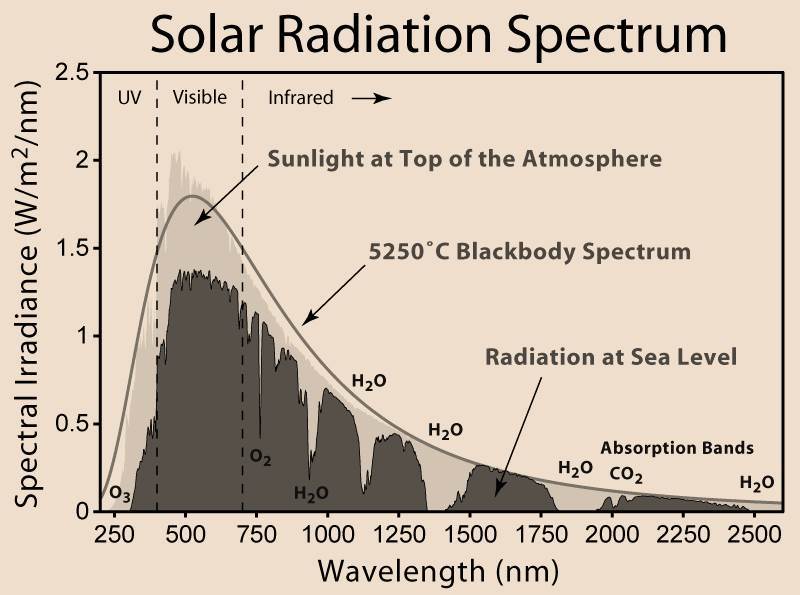
Figure 1 shows the solar radiation spectrum.

Figure 2 shows the rate of photosynthesis and the amounts of sunlight in the various wavelengths that are absorbed by the chlorophyll in plants.

Figure 3 shows Spectral Response of solar cells.

Figure 4 shows Spectral response of conventional and transparent PV cells.

Figure 5 shows a sample of a commercial Thin Film solar PV in fabric form. (reference available on request.)

Figure 6 shows how stacking takes advantage of the solar radiation spectrum and the spectral response of photovoltaic panels.

Figure 7 shows how the wavelength spectra can be matched so that the solar radiation can be appropriately shared and utilized by the series of devices.

Figure 8 shows a view of stacked solar PV panels and solar hot water heaters on a transparent roof of a solar coolhouse.

Figure 9 shows a sketch of the general arrangement of the solar coolhouse.

Figure 10 shows a schematic arrangement of the solar coolhouse.

Figure 11 shows a view of the ventilation arrangement in the gable portion of the roof of the coolhouse.

Figure 12 shows a coolhouse with the addition of a rock bed recuperator.

Figure 13 shows a solar coolhouse with hydroponics or aquaponics instead of soil based plants grown inside the solar coolhouse.

Figure 14 shows a solar coolhouse with pisciculture cultivation.
References and Prior Patents:
Available upon request.
Subscribe to:
Posts (Atom)